• Skip to primary navigation
  • Skip to main content
  • Skip to primary sidebar
  • Skip to footer
  • Home
  • About
    • What is Beyond Broken?
    • My Story
    • Credentials
    • Trauma Work
    • About Pathwork
  • Sessions and Supervision
  • Stories
  • Writing
  • Contact

Beyond Broken

Relationship

“I know I am imperfect, but I make believe I am not”

May 1, 2019

A collaboration of various authors on the subject of the Idealized Self Image, the damage it does and the promise of recovery  – into our sacred humanness.  Our true nature.  Thank you to all you brave souls who contributed. 
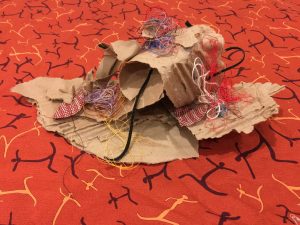
Image Above – The Idealized Self Image as Constructed by Susan G. — variegated cardboard is material she visualized, flimsy and inadequate for supporting all the structures she puts on top.  She adorns it with various ornamentation – random, without coherence.  This is a beautiful portrayal of the idealized self.  Individually each piece representing a belief about life and ourselves, makes sense but the overall construction … well draw your own conclusions!

A Pathwork Lecture says, “As a child, regardless of what your particular circumstances were, you were indoctrinated with admonitions on the importance of being good, holy, perfect.  When you were not, you were often punished in one way or another.  Perhaps the worst punishment was that your parents withdrew their affection from you; they were angry, and you had the impression you were no longer loved.  No wonder “badness” associated itself with punishment and unhappiness, “goodness” with reward and happiness.  Hence to be “good” and “perfect” became an absolute must; it became a question of life or death for you.  Still you knew perfectly well that you were not as good and as perfect as the world seemed to expect you to be.  This truth had to be hidden; it became a guilty secret, and you started to build a false self.” PWL #83

I am working with several people who are doing the sacred work of deconstructing the mask of the Idealized Self that they have constructed over so many years.  The Idealized Self Image is what the Pathwork calls the perfectionist standards that we hold ourselves to and present to the world.  The ISI is made of many images  (beliefs about the world and ourselves that we formed during our sorting and categorizing stage of our brain development.  My four year old grandchild is doing this now.  “I have a penis, Daddy has a penis  – you and Mommy do not have penises”.  The conclusions he will draw about men and women will form a lasting image that will become unconscious because of his young age.  Many images also contain conclusions about cause and effect.  The young one trying to make order and sense out of the world.  If I do this _______ then that ________ will always happen.  We have a myth in our family – if you wear your pajamas inside out it will snow when you wake up the next morning.  Some of our unconscious images can be just as magical or erroneous as this one and make little sense in the light of day of our grown up psyches.

Here is one example.  It begins with her belief  that, “I am  special and therefore inoculated against anything bad happening to me.”  (We can smile at the magical thinking of her little one). “Next, something bad does happen.  Then I decides I better hide and make myself  small.” (This plays out in adulthood with eating disorders and other issues). ” But then I am hungry, and so lonely and so afraid.  If I keep making myself a better (special) person maybe that will help. But then I fail at my expectations and bad things keep happening and I hide and get small again.  The world feels like a very unsafe place.”  This is something that all Idealized Self Images have in common.  The world does not feel safe….

Read More

Filed Under: Pathwork, Relationship, Self Exploration, Trauma Tagged With: whubbard

Attachment Hell

January 31, 2019

What is Attachment and why is it Hell when things go wrong?

attachment

If you had an ideal childhood where your consistent parents celebrated your uniqueness and each of your achievements as you moved through your developmental stages, then this blog does not apply to you.

“However, most of us had a childhood that was far from this ideal. Our young, vulnerable nervous systems were not protected and regulated by ideal parents. We often felt overwhelmed and alone, and to buffer ourselves from these recurring feelings of overwhelm, we developed survival patterns”, says Steven Kessler in The 5 Personality Patterns.

These survival patterns can stay with us our whole lives and we identify them as ‘us’.  However they are a series of defensive postures that help us regulate energy and events from the outside world. The real ‘us’ of us — our essence — is lost, since it was not activated by attunement when were were young. The good news is we can recover our truest selves, but it takes work.  We have to begin the process of attuning to ourselves, attending to those overwhelmed and lonely parts within.

If your parent or parents were there, but not consistently, you will believe that if you ramp up your nervous system and attention to others, maybe that will make them stay with you longer.  You live a very vigilant, anxious life in a terrible quandary: your need for others is so large, but your capacity to take it in is so small (since it was not there sufficiently when you were young). To heal and find your way back to your real self you will need to practice receiving and containing.  You have what you need now to fill up your system and regulate yourself but you will have to work at it.  You also have to pay special attention to letting in the goodness that comes your way, letting it land in you. You will have to reverse your focus from outward to inward. You will feel whole and settled as if you have finally come home.

A testimony to this work –

“So first, I would say I am healing from my attachment wound.  Part of this process is knowing my vulnerability to the story/feelings of being left, especially in my closest relationships.  When I am getting pulled to the old pattern of relating, I know I need to slow down and hold myself with love and compassion so I don’t abandon me.  This allows me to be intimate with myself and my real needs while creating opportunity for intimacy with the other. I risk asking for what I need.  I am clear about what is a true request versus a whiny demand or manipulation.  If I’m feeling whiny energy, this needs to be held and explored. And surprise to my younger self:  My requests are usually met with a yes!  And when they are not, it allows me to open to other paths to getting my desires met.”  Anonymous

If your parents were not available especially emotionally, you will stop expecting anything from others. You will live life in your own bubble. You will overrate your opinions and views of the world and discredit others. You will not allow yourself to have any needs since they will not be met, but your quandary is that, to do this, you must make yourself numb. This numbness helps you regulate difficult, overwhelming experiences but you will also be numb to joy and much of the pleasure that life offers. To heal you will need to take the risk to slowly step our of your bubble and notice that there is nourishment for you there. You will have to slowly let your body feel again and risk having your needs. You will feel more of everything: love, joy, pain and your old drab life will take on unbelievable colors.

A testimony to this work –

“Understanding my attachment style has allowed me to accept actions and beliefs that I previously thought were an unchangeable part of ‘who I was’. Not accepting them kept these patterns of behavior in place and created a profound sense of isolation and personal failure. As I have grown to accept these patterns as legitimate outcomes of my childhood experiences, new possibilities are opening up to choose differently; choosing connection rather than isolation and hopelessness. I now have a loving partner who both understands me and yet is available for a deep intimacy that I have never previously known. An inner gate has opened and although my old responses and patterns occasionally show themselves, I recognize them for what they are: ghosts that no longer have power to bind me to past vows. I have a real choice now and I choose love more and more often. True and justified hope is now mine. ” Jack Bodger

If your parents, who you needed to love you, also hurt you — well then you are really in trouble.  Your quandary is the belief that love = harm or hurt. This will make it very challenging for you to form healthy lasting relationships as an adult. You will be drawn to the love and repelled by the harm. You are like a magnet turning towards the attraction of love and then flipping over and repelling that connection out of fear. Unfortunately, some of us in this category experienced child abuse in the form of physical and emotional harm. Others of us experienced neglect which creates tremendous hurt in a young child.

This is what happened to one dear little one who was subjected to treatment by heartless immigration tactics, separated from his parents with no warning for 73 days. He experiences this as extreme neglect. His mother is there one moment and then gone the next. His master regulator of all those overwhelming and lonely feelings is suddenly gone. He becomes extremely dis-regulated, and this may last throughout his life. You see this dramatically in the news video of his reunion with his mother. He will repeat this in every relationship for the rest of his life. This clip, from the CBS New “60 Minutes” program, includes commentary from two psychiatrists.

https://beyondbroken.org/wp-content/uploads/IMG_1006.m4v

…

Read More

Filed Under: Attachment, Relationship, Self Exploration, Trauma

YOUNG LOVE

January 7, 2019

“We sail and we sail together.
The name of our ship is the new beginning
and our sails are a hopeful color.
Filled with the winds of changing times.
We sail and sea around us waves.
And it swells as a great heart beating.
All the storms of night are passing.
How can we sink when we can fly?”

From the cover of my leadership camp’s handbook 1971

“When you are 15, or thereabouts, you love the art you love more passionately than you will ever love art again.  Around that time your sense of taste has only just recently come into being. ….. You have been transformed from a kid… to a young adult with an ‘aesthetic’.”

—From Jonah Weiner Rage Against the Machine, New York Times Magazine

In the summers when I was 16 and 17 I was sent, by scholarship, to a leadership camp in Upstate New York.  By day, we did social action, building a playground for migrant worker children and by night we discussed the deep questions of religion and spirituality.  On weekends we would clean up and dress in all white and sing and dance our hearts out.  This was my art, my aesthetic.  I fell in love.  Looking back 49 years later, I am sure that my fellow campers and what we created together saved my life.

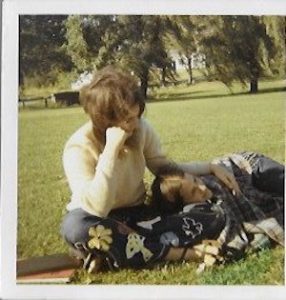
Recently one of my best friends from camp found me on Facebook.  She then posted this picture from 1972 of the two of us sitting on the grass near our beloved pond – my head in her lap.  As I gaze at that photo, I know that is still me.  I love intimate contact, and thrive on the meaningful conversation.  We had many that summer about love, life and God…..

Read More

Filed Under: Attachment, Pathwork, Relationship, Self Exploration, Trauma

Redemption

February 15, 2018

Redemption

An act of redeeming or atoning for a fault or mistake and returning to a state of being redeemed.

Here is what happened for me. I married my husband when I was 26. I was a very young 26. I needed a mother and a father as much as I wanted a husband. He was going to make up for all my losses — a happy ending to a sad life.

It wasn’t so easy. He had two young boys in our care. They were 5 and 7 and had lots of NEEDS. I did not understand what it meant to be a wife, let alone a mother. I did my best at each of those tasks and I wasn’t very good at them. Most of the time I was resentful of everyone else’s needs and competed with them for my husbands attention. And I was so afraid to love. What if they did not love me back? I had no understanding of, or way to hold this negativity inside. The little boys were cute, creative and so smart. How could I feel so mean? I hated myself ­— guilt, fear and resentment forming a toxic mix….

Read More

Filed Under: Attachment, Relationship

Are you keeping ‘cool’ this summer or succumbing to the heat?

July 11, 2017


Are you keeping ‘cool’ this summer or succumbing to the heat?

Learn more about what happens in our brain during ‘cool’ and ‘hot’ moments and what huge differences it makes in our relationships.

We are only three weeks into the summer and already there has been a lot to learn.  Most of us continuously find ourselves judging others and making assumptions about other people’s behaviors. We do this continuously in a scanning function in our brain. These assumptions justify our defensive behaviors. Our untested ‘realities’ give rise to disconnection, wall building and subtle and not so subtle negativity in our relationships.
…

Read More

Filed Under: Attachment, Relationship, Self Exploration, Trauma

  • « Go to Previous Page
  • Page 1
  • Interim pages omitted …
  • Page 3
  • Page 4
  • Page 5
  • Page 6
  • Go to Next Page »

Primary Sidebar

Wendy Hubbard

About Wendy

Wendy Hubbard, M.Ed., SEP, is a Pathwork Helper and Somatic Experiencing (SE) Practitioner. She has studied and practiced the Pathwork® for 25 years and SE for 10 years. She is also certified in Hellinger Family Constellation Work and Dynamic Attachment Re-patterning Experience (DARe). This rich mix of modalities and trainings informs her work and enables her to bring hope and healing to her clients. She provides individual and couples sessions and leads therapeutic groups and trainings, often with her husband, Pathwork Helper Tom Hubbard.

Read more about Wendy...

Call: 434-531-5310

Footer

The Latest from Wendy…

watercolor flowers

Listening and Yielding

Our stories reveal our hearts. I collect them. Yet it is hard to hear and relax into my own present story amidst all the frantic activity and noise. And I am learning how to relax and follow my heart in new ways. I hope my story will help you find your own.

Read More

Quick Links

  • Sessions and Supervision
  • About Wendy
  • Pathwork®
  • Contact

Connect with Wendy

Call: 434-531-5310

  • Email
  • Facebook
  • RSS
  • YouTube

© 2026 Wendy Hubbard, M.Ed., SEP, Charlottesville, Virginia
Web development by EJ Communications