• Skip to primary navigation
  • Skip to main content
  • Skip to primary sidebar
  • Skip to footer
  • Home
  • About
    • What is Beyond Broken?
    • My Story
    • Credentials
    • Trauma Work
    • About Pathwork
  • Sessions and Supervision
  • Stories
  • Writing
  • Contact

Beyond Broken

Pathwork

“I know I am imperfect, but I make believe I am not”

May 1, 2019

A collaboration of various authors on the subject of the Idealized Self Image, the damage it does and the promise of recovery  – into our sacred humanness.  Our true nature.  Thank you to all you brave souls who contributed. 
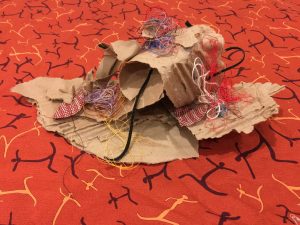
Image Above – The Idealized Self Image as Constructed by Susan G. — variegated cardboard is material she visualized, flimsy and inadequate for supporting all the structures she puts on top.  She adorns it with various ornamentation – random, without coherence.  This is a beautiful portrayal of the idealized self.  Individually each piece representing a belief about life and ourselves, makes sense but the overall construction … well draw your own conclusions!

A Pathwork Lecture says, “As a child, regardless of what your particular circumstances were, you were indoctrinated with admonitions on the importance of being good, holy, perfect.  When you were not, you were often punished in one way or another.  Perhaps the worst punishment was that your parents withdrew their affection from you; they were angry, and you had the impression you were no longer loved.  No wonder “badness” associated itself with punishment and unhappiness, “goodness” with reward and happiness.  Hence to be “good” and “perfect” became an absolute must; it became a question of life or death for you.  Still you knew perfectly well that you were not as good and as perfect as the world seemed to expect you to be.  This truth had to be hidden; it became a guilty secret, and you started to build a false self.” PWL #83

I am working with several people who are doing the sacred work of deconstructing the mask of the Idealized Self that they have constructed over so many years.  The Idealized Self Image is what the Pathwork calls the perfectionist standards that we hold ourselves to and present to the world.  The ISI is made of many images  (beliefs about the world and ourselves that we formed during our sorting and categorizing stage of our brain development.  My four year old grandchild is doing this now.  “I have a penis, Daddy has a penis  – you and Mommy do not have penises”.  The conclusions he will draw about men and women will form a lasting image that will become unconscious because of his young age.  Many images also contain conclusions about cause and effect.  The young one trying to make order and sense out of the world.  If I do this _______ then that ________ will always happen.  We have a myth in our family – if you wear your pajamas inside out it will snow when you wake up the next morning.  Some of our unconscious images can be just as magical or erroneous as this one and make little sense in the light of day of our grown up psyches.

Here is one example.  It begins with her belief  that, “I am  special and therefore inoculated against anything bad happening to me.”  (We can smile at the magical thinking of her little one). “Next, something bad does happen.  Then I decides I better hide and make myself  small.” (This plays out in adulthood with eating disorders and other issues). ” But then I am hungry, and so lonely and so afraid.  If I keep making myself a better (special) person maybe that will help. But then I fail at my expectations and bad things keep happening and I hide and get small again.  The world feels like a very unsafe place.”  This is something that all Idealized Self Images have in common.  The world does not feel safe….
Read More

Filed Under: Pathwork, Relationship, Self Exploration, Trauma Tagged With: whubbard

YOUNG LOVE

January 7, 2019

“We sail and we sail together.
The name of our ship is the new beginning
and our sails are a hopeful color.
Filled with the winds of changing times.
We sail and sea around us waves.
And it swells as a great heart beating.
All the storms of night are passing.
How can we sink when we can fly?”

From the cover of my leadership camp’s handbook 1971

“When you are 15, or thereabouts, you love the art you love more passionately than you will ever love art again.  Around that time your sense of taste has only just recently come into being. ….. You have been transformed from a kid… to a young adult with an ‘aesthetic’.”

—From Jonah Weiner Rage Against the Machine, New York Times Magazine

In the summers when I was 16 and 17 I was sent, by scholarship, to a leadership camp in Upstate New York.  By day, we did social action, building a playground for migrant worker children and by night we discussed the deep questions of religion and spirituality.  On weekends we would clean up and dress in all white and sing and dance our hearts out.  This was my art, my aesthetic.  I fell in love.  Looking back 49 years later, I am sure that my fellow campers and what we created together saved my life.

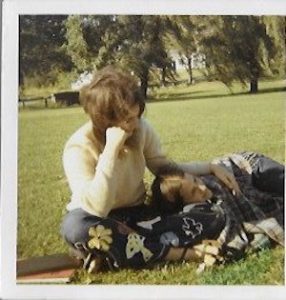
Recently one of my best friends from camp found me on Facebook.  She then posted this picture from 1972 of the two of us sitting on the grass near our beloved pond – my head in her lap.  As I gaze at that photo, I know that is still me.  I love intimate contact, and thrive on the meaningful conversation.  We had many that summer about love, life and God…..

Read More

Filed Under: Attachment, Pathwork, Relationship, Self Exploration, Trauma

Healing The Shame Of Sexuality

August 16, 2018

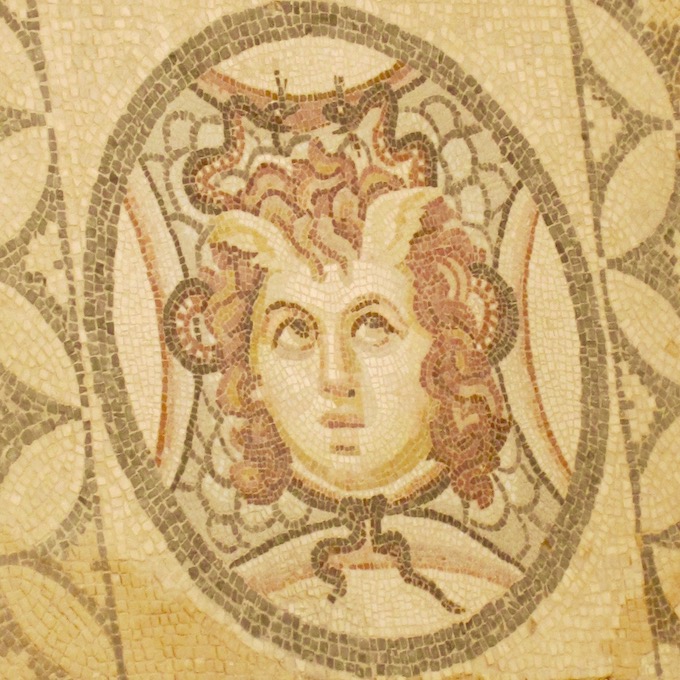
(Photo taken at Ephesus, a Greek and then Roman city that flourished around the time of Christ)


I have been exploring Dan Siegel’s Wheel of Awareness in which he describes the hub of awareness as the center of ourselves and the spokes and rim as the things we take in from the  outside world: our senses, our mind thoughts, our relationships, our body sensations.

Practicing this for several days I became interested in my hub, the essence of me that is me — the center.

This is a new variation on many practices of I have tried over the years.  I have always found some resistance to going into the center of myself.  In the past I have  thought I was afraid of how little would be there, that I would find that I am really just made up of everything going on outside of me.  I am very ‘other’ focused.

This time I began to notice something new stir in the center of my being.  The word feminina came into my consciousness.   It is a word my husband uses to refer to me often.  The word means feminine in Portuguese.  I have noticed that I have a slight aversion to him calling me this name.

This aversion, as I really explore it, contains a lot of strong emotions and is a microcosm of myself as a sexual woman — fear, shame and lust.  In the center of my being I find my sexuality as an integral part of the essential me!

When I was becoming a woman at age 14, my mother was becoming a man.  She had a radical mastectomy and then took hormone treatment which made her voice lower, and hair grow on her face.  This was horrifying to me and I understood — this happens when you are a woman.  I also knew that  for women there was another type of danger, whispers of pregnancies, getting in trouble, being a bad girl.

My own budding sexuality, although active, went into hiding, laced with shame and isolation.

This may be a common experience for women even though my coming of age experience with my mother was unusual.  The photo above depicts  Medusa looking very ambivalent herself, some 2000+ years ago. It adorned a wall of a home in ancient Ephesus.

If I am Feminina, what does that mean?  Pressure to be something, the receptacle of endless need?  I have not had many positive associations.  AND that is changing!…

Read More

Filed Under: Pathwork, Self Exploration, Trauma

The Dry Desert of Self Contempt

May 27, 2018

Each of us has words we say to ourselves silently that we would never speak out loud to anyone else.  These words become so familiar they barely reach conscious thought but they carry very negative energy.  With my clients we have excavated phrases like “you are such an idiot”, “you are a fat big”, “you do not even deserve to live”, or “you are worthless” and more.  You might be interested in listening for what you say to yourself.  This self-contempt is so painful, but is actually meant to protect us.  If we say these things to ourselves we will fend off the criticism of others.  We will whip ourselves into better shape (smarter, thinner, deserving, etc).  Sometimes these words were said to us and we have internalized them.  Sometimes we just lived in an environment where our significant others interacted with us in a way to make us draw these conclusions.  For example, one of my client’s Dad was a policeman.  When he came home after a long day of work all he wanted to do was watch police chase videos on TV or Pornography on the computer which was in the living room.  His Dad did not delight in him or show interest in him.  He drew the conclusion that he must be an idiot and he now has trouble focusing on tasks — finishing things he starts.  This of course confirms his phrase “You are such an idiot”.

The healing of this dynamic has some challenging but very clear steps.  Self-contempt is in our control.  First we have to excavate these phrases.  Listen for them in our background thoughts and self talk.  Then we have to challenge their validity.  Is it true I am idiot?  A fat pig?  This challenge immediately softens the energy these phrases carry.  Next we have to go into the early scenarios that began this self talk.  Go into the living room and feel how much you wanted your Dad’s attention and how he was not interested in you.  As you feel this also allow yourself to feel how this really happened to you.  You were a cute, creative kid.  You deserved attention and support.  You needed it.  Once you allow yourself to feel your feelings and really validate what happened, you are on your way to healing….

Read More

Filed Under: Attachment, Pathwork, Self Exploration

PURITY

May 3, 2018

While at the beach in Florida this winter I had a casual conversation with a stranger.  We quickly found we shared step-parenting.  Both of us each wrested with feeling included in a family not of our own making (at least biologically).

I agreed to send her an article I was reading about cultivating the good amidst our tendencies to see how we don’t belong or might be excluded.

The next day I saw her again on the beach and she said I had made an impression on her.  Like a yoga teacher she knew once, “I was pure”.  In the moment I dismissed what she said.  I found no place in myself to connect with purity.

I have fallen out of contact with Marie but her words stayed with me.  For a time they stayed in the periphery of my mind.  But I woke yesterday from a dream in which I was in bed, with purity as a young daughter lying  next to me.

What if I used the exercises of the great teachers, Tara Brach and John Welwood to make space and really embody this feeling of purity?  They both have similar four-part exercises to make space for, embody and receive support for difficult feelings.  What if this exercise worked for positive feelings too?…

Read More

Filed Under: Pathwork, Self Exploration

  • « Go to Previous Page
  • Page 1
  • Page 2
  • Page 3
  • Page 4
  • Page 5
  • Go to Next Page »

Primary Sidebar

Wendy Hubbard

About Wendy

Wendy Hubbard, M.Ed., SE, is a Pathwork Helper and Somatic Experiencing (SE) Practitioner. She has studied and practiced the Pathwork® for 25 years and SE for 10 years. She is also certified in Hellinger Family Constellation Work and Dynamic Attachment Re-patterning Experience (DARe). This rich mix of modalities and trainings informs her work and enables her to bring hope and healing to her clients. She provides individual and couples sessions and leads therapeutic groups and trainings, often with her husband, Pathwork Helper Tom Hubbard.

Read more about Wendy...

Call: 434-531-5310

Footer

The Latest from Wendy…

watercolor flowers

Listening and Yielding

Our stories reveal our hearts. I collect them. Yet it is hard to hear and relax into my own present story amidst all the frantic activity and noise. And I am learning how to relax and follow my heart in new ways. I hope my story will help you find your own.

Read More

Quick Links

  • Sessions and Supervision
  • About Wendy
  • Pathwork®
  • Contact

Connect with Wendy

Call: 434-531-5310

  • Email
  • Facebook
  • RSS
  • YouTube

Copyright Wendy Hubbard, Charlottesville, Virginia
Web development by EJ Communications