• Skip to primary navigation
  • Skip to main content
  • Skip to primary sidebar
  • Skip to footer
  • Home
  • About
    • What is Beyond Broken?
    • My Story
    • Credentials
    • Trauma Work
    • About Pathwork
  • Sessions and Supervision
  • Stories
  • WORKSHOPS
    • Women’s Wellness Weekend 2025
  • Writing
  • Contact

Beyond Broken

Attachment

YOUNG LOVE

January 7, 2019

“We sail and we sail together.
The name of our ship is the new beginning
and our sails are a hopeful color.
Filled with the winds of changing times.
We sail and sea around us waves.
And it swells as a great heart beating.
All the storms of night are passing.
How can we sink when we can fly?”

From the cover of my leadership camp’s handbook 1971

“When you are 15, or thereabouts, you love the art you love more passionately than you will ever love art again.  Around that time your sense of taste has only just recently come into being. ….. You have been transformed from a kid… to a young adult with an ‘aesthetic’.”

—From Jonah Weiner Rage Against the Machine, New York Times Magazine

In the summers when I was 16 and 17 I was sent, by scholarship, to a leadership camp in Upstate New York.  By day, we did social action, building a playground for migrant worker children and by night we discussed the deep questions of religion and spirituality.  On weekends we would clean up and dress in all white and sing and dance our hearts out.  This was my art, my aesthetic.  I fell in love.  Looking back 49 years later, I am sure that my fellow campers and what we created together saved my life.

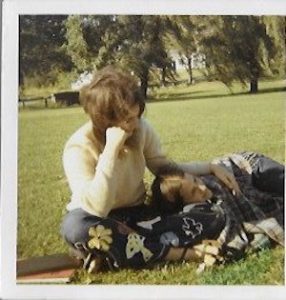
Recently one of my best friends from camp found me on Facebook.  She then posted this picture from 1972 of the two of us sitting on the grass near our beloved pond – my head in her lap.  As I gaze at that photo, I know that is still me.  I love intimate contact, and thrive on the meaningful conversation.  We had many that summer about love, life and God…..
Read More

Filed Under: Attachment, Pathwork, Relationship, Self Exploration, Trauma

Are You Resilient?

October 27, 2018

What is Resilience?

It has been called the great puzzle of human nature.

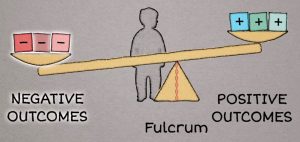
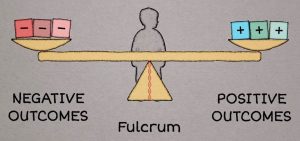
Is it something some people have and others do not?  Is it something you can learn?  Some research on resilience talks about genetics and a predisposition towards resilience.  Here are diagrams of a seesaw with a fulcrum to illustrate this.   Your life experiences and genetic predispositions sets this fulcrum to make your seesaw go up or down more easily.  Adverse childhood experiences make moving the fulcrum more challenging.  It can even make resilience out of reach for some people.

However, it is people who have had the most adverse life experiences and somehow have overcome them that inspire us the most.  Who are these people and what did they do?  The answer to these questions can help us understand resilience.

Resilient people possess three characteristics: a staunch acceptance of reality; a deep belief  that life is meaningful; and an uncanny ability to improvise. You can bounce back from hardship with just one or two of these qualities, but you will only be truly resilient with all three.

Viktor Frankl was preoccupied with survivorship/resilience during his dehumanizing, life threatening experiences in concentration camps in Nazi Germany.  He later traced the roots of his resilience to a sense of purpose and the acquisition of meaning.  He then expanded meaning into three dimensions: purpose, mastery and autonomy. He wrote about in his famous book, “Man’s Search For Meaning”.

Other core characteristics of resilient people include the ability to form strong attachments to others and the possession of an inner psychological space that protects them from intrusion or abuse.

“More than education, more than experience, more than training, a person’s level of resilience will determine who succeeds and who fails. That’s true in the cancer ward, it’s true in the Olympics, and it’s true in the boardroom,” says Dean Becker, the president and CEO of Adaptiv Learning Systems, quoting from Diane Coutu in her Harvard Review Article, “How Resilience Works.”

So how can we train ourselves to become more resilient?…

Read More

Filed Under: Attachment, Self Exploration, Trauma

The Dry Desert of Self Contempt

May 27, 2018

Each of us has words we say to ourselves silently that we would never speak out loud to anyone else.  These words become so familiar they barely reach conscious thought but they carry very negative energy.  With my clients we have excavated phrases like “you are such an idiot”, “you are a fat big”, “you do not even deserve to live”, or “you are worthless” and more.  You might be interested in listening for what you say to yourself.  This self-contempt is so painful, but is actually meant to protect us.  If we say these things to ourselves we will fend off the criticism of others.  We will whip ourselves into better shape (smarter, thinner, deserving, etc).  Sometimes these words were said to us and we have internalized them.  Sometimes we just lived in an environment where our significant others interacted with us in a way to make us draw these conclusions.  For example, one of my client’s Dad was a policeman.  When he came home after a long day of work all he wanted to do was watch police chase videos on TV or Pornography on the computer which was in the living room.  His Dad did not delight in him or show interest in him.  He drew the conclusion that he must be an idiot and he now has trouble focusing on tasks — finishing things he starts.  This of course confirms his phrase “You are such an idiot”.

The healing of this dynamic has some challenging but very clear steps.  Self-contempt is in our control.  First we have to excavate these phrases.  Listen for them in our background thoughts and self talk.  Then we have to challenge their validity.  Is it true I am idiot?  A fat pig?  This challenge immediately softens the energy these phrases carry.  Next we have to go into the early scenarios that began this self talk.  Go into the living room and feel how much you wanted your Dad’s attention and how he was not interested in you.  As you feel this also allow yourself to feel how this really happened to you.  You were a cute, creative kid.  You deserved attention and support.  You needed it.  Once you allow yourself to feel your feelings and really validate what happened, you are on your way to healing….

Read More

Filed Under: Attachment, Pathwork, Self Exploration

Redemption

February 15, 2018

Redemption

An act of redeeming or atoning for a fault or mistake and returning to a state of being redeemed.

Here is what happened for me. I married my husband when I was 26. I was a very young 26. I needed a mother and a father as much as I wanted a husband. He was going to make up for all my losses — a happy ending to a sad life.

It wasn’t so easy. He had two young boys in our care. They were 5 and 7 and had lots of NEEDS. I did not understand what it meant to be a wife, let alone a mother. I did my best at each of those tasks and I wasn’t very good at them. Most of the time I was resentful of everyone else’s needs and competed with them for my husbands attention. And I was so afraid to love. What if they did not love me back? I had no understanding of, or way to hold this negativity inside. The little boys were cute, creative and so smart. How could I feel so mean? I hated myself ­— guilt, fear and resentment forming a toxic mix….

Read More

Filed Under: Attachment, Relationship

Beyond Dreaming

October 22, 2017

Beyond Dreaming

We all dream.  Our dreams take the form of fantasies, day dreams and dreams while we sleep.  Dreams have different purposes.  One purpose is to correct reality.  You fix what is broken or unredeemable in fantasy — your wish for real life played out in dreams.  You  seek revenge or pride where there was humiliation.   You win where you have lost.  You are powerful where you were powerless.  Our dreams can be very soothing.  And it is very powerful to observe them rather than get lost in them.
…

Read More

Filed Under: Attachment, Pathwork, Self Exploration, Trauma

  • « Go to Previous Page
  • Page 1
  • Interim pages omitted …
  • Page 4
  • Page 5
  • Page 6
  • Page 7
  • Page 8
  • Go to Next Page »

Primary Sidebar

Wendy Hubbard

About Wendy

Wendy Hubbard, M.Ed., SEP, is a Pathwork Helper and Somatic Experiencing (SE) Practitioner. She has studied and practiced the Pathwork® for 25 years and SE for 10 years. She is also certified in Hellinger Family Constellation Work and Dynamic Attachment Re-patterning Experience (DARe). This rich mix of modalities and trainings informs her work and enables her to bring hope and healing to her clients. She provides individual and couples sessions and leads therapeutic groups and trainings, often with her husband, Pathwork Helper Tom Hubbard.

Read more about Wendy...

Call: 434-531-5310

Footer

The Latest from Wendy…

watercolor flowers

Listening and Yielding

Our stories reveal our hearts. I collect them. Yet it is hard to hear and relax into my own present story amidst all the frantic activity and noise. And I am learning how to relax and follow my heart in new ways. I hope my story will help you find your own.

Read More

Quick Links

  • WORKSHOPS
  • Sessions and Supervision
  • About Wendy
  • Pathwork®
  • Contact

Connect with Wendy

Call: 434-531-5310

  • Email
  • Facebook
  • RSS
  • YouTube

Copyright Wendy Hubbard, Charlottesville, Virginia
Web development by EJ Communications